Ink
Ink


 Machines


 Cartridges


 Studio supplies


 Power & batteries


 Aftercare


 Traditional tattooing


 Apprentice


 Piercing & jewellery


 PMU supplies


 New arrivals
 Sale
Sale
 Gift vouchers
 Shop all


 March 13, 2026
-
4 months ago
March 13, 2026
-
4 months ago
Every client who sits in your chair is trusting you with their health. That trust goes beyond your artistic skill. It comes down to the standards you hold in your studio, the equipment you use, and the habits you follow every single session.
Infection control best practices for professional tattoo studios are not just regulatory boxes to tick. They are the foundation of safe, professional tattooing. Get them right, and you protect your clients, your reputation, and your business.
This guide covers everything you need to know, from single-use equipment to autoclave sterilisation, hygiene compliance, and what inspectors look for when they walk through your door.
Understanding Infection Risks in Tattoo Studios
Tattooing breaks the skin barrier. That makes it an invasive procedure, and any such procedure carries a risk of infection if hygiene standards are not followed.
Understanding where those risks come from is the first step towards running a studio that keeps everyone safe.
Why Cross-Contamination Is Your Biggest Risk
Cross-contamination happens when contaminated surfaces, equipment, or hands come into contact with open skin or sterile items. It is one of the most common causes of infection in tattoo environments.
Bloodborne pathogens such as hepatitis B, hepatitis C, and HIV can survive on surfaces and equipment if your studio's sanitation protocol is not followed correctly. Bloodborne pathogen safety is not optional. It is a core part of what it means to work professionally.
Professional studio safety procedures are your first line of defence. The habits you build around hygiene are what protect both you and your clients throughout every session.
Why Strict Hygiene Protocols Protect Artists Too
Clean studios protect more than your clients. Artists are exposed to blood and bodily fluids during every session. Clinical hygiene practices reduce your own risk of exposure just as much as they protect the person in your chair.
A studio with strong infection-prevention standards also builds long-term client trust. People talk. Your hygiene reputation matters as much as your portfolio.
The Role of Single-Use Equipment in Infection Control
The tattoo industry shifted to single-use equipment for good reason. Disposable tools eliminate the risk of cross-contamination between clients. There is no margin for error, no reliance on sterilisation equipment functioning correctly, and no risk of residual contamination from a previous session.
All needles used in professional tattooing must be single-use and disposed of in an approved sharps container. That is a legal requirement under UK health and safety regulations, not just good practice.
Why Single-Use Needles Are Non-Negotiable
Reusing a needle, even after cleaning, cannot guarantee it is free from bloodborne pathogens. Sterilisation of used needles is not a compliant alternative to disposal. Once a needle has been used, it goes into a sharps bin. That is the standard.
Sterile tattoo procedures depend on this. Using a fresh, sterile needle for each client is the cornerstone of infection-prevention standards in any reputable studio.
Essential Disposable Supplies Every Studio Should Have
A complete single-use checklist covers more than just needles. You should replace the following between clients: tattoo needles and cartridges, ink caps and cup holders, barrier film on machines, power supplies and bottles, gloves and aprons, couch roll or bed covers, and razor blades if skin preparation is needed.
Barrier protection techniques are just as important as the disposable items themselves. Wrapping your machine and spray bottles prevents contamination from reaching reusable equipment during a session.
Safe Use of Reusable Tattoo Equipment
Not all tattoo equipment is single-use. Some tools can be reused legally and safely, but only when they undergo a validated sterilisation process between clients.
If reusable equipment is part of your setup, the process you follow needs to be thorough, documented, and consistent every single time.
What Equipment Needs Sterilising Between Clients
Equipment that requires sterilisation between clients includes reusable grips and tubes, stainless steel tips, certain machine components, and any other item that has come into contact with blood or bodily fluids.
Clinical hygiene practices also require you to clean and decontaminate your workstation, chair, and tray surfaces between clients using an appropriate disinfectant.
Autoclave Sterilisation Is the Only Accepted Standard
When it comes to sterilising reusable tattoo tools, autoclave sterilisation is the gold standard. Steam autoclaving is classified as medical-grade sterilisation and is the method accepted by UK Environmental Health departments.
Other methods, such as UV light sanitisers, chemical soaks, or dry heat, are not sufficient for items that have been in contact with blood. They cannot meet the infection-prevention standards required for reusable tattoo equipment.
An autoclave uses pressurised steam at high temperatures to destroy bacteria, viruses, and spores on equipment surfaces. For the process to be valid, every cycle must be properly logged with the date, time, cycle temperature, and items sterilised.
Can Autoclaved Tattoo Grips Be Reused Safely
Yes. Autoclaved tattoo grips are safe to reuse when the sterilisation process has been correctly followed and documented. The grip must first be cleaned of all visible debris, bagged in a heat-seal sterilisation pouch, and then processed through a validated autoclave cycle.
The bagged, sterilised grip must remain sealed until the start of a new client session. Once opened or handled with contaminated gloves, it must be resterilised before use on another client.
Featured Product: Granton Medical Self-Seal Sterilisation Pouches
Self-seal sterilisation pouches are suitable for both autoclave and ethylene oxide sterilisation methods. Made from heavyweight 70gsm paper with a blue-tinted transparent laminate film and built-in indicator strips that confirm a successful sterilisation cycle. Available in six sizes to suit grips, tips, jewellery, and instruments.
Expert Skin Care and Studio Sanitation
Maintaining a sterile environment is the foundation of every professional tattoo, ensuring both artist safety and client health. Professional skin care and studio sanitation begin with medical-grade skin preparation to remove bacteria without causing irritation, paired with high-level surface disinfectants to eliminate cross-contamination.
By using industry-standard solutions for every workstation teardown and skin-cleansing step, you uphold an aseptic technique that protects the integrity of your art. This rigorous hygiene protocol not only ensures a safer healing process but also reinforces the professional trust your clients expect from a top-tier studio.
Green Soap: Professional Skin Care and Hygiene
Green soap is one of the most widely used products in professional tattoo studios. It keeps the skin clean before, during, and after tattooing, helping remove excess ink and blood without irritating the skin. Using the right green soap in your infection control routine matters. It is not a sterilising agent on its own, but it is an essential part of daily hygiene practice in any compliant studio.
How to Use Green Soap Correctly
Dilute your green soap concentrate according to the manufacturer's directions. Fill your spray bottle fresh for each client and never let the tip of the bottle touch the skin. Cross-contamination from spray bottles is a common and avoidable risk.
Green soap is used before tattooing to prepare and clean the skin, during the session to remove excess ink and blood, and after to clean the area before applying a bandage. It should always be used alongside other hygiene measures, not as a substitute for them.
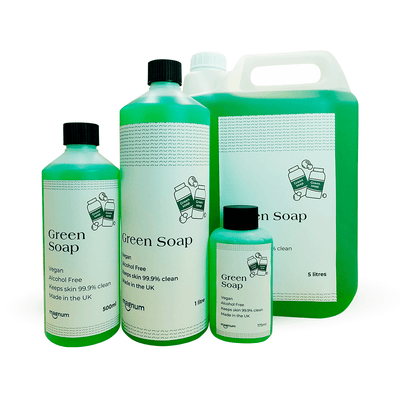
Featured Product: Magnum Antibacterial Green Soap
A naturally soothing, aloe vera-enriched antibacterial green soap made in the UK and suitable for vegans. Kills 99.9% of germs and is gentle on the skin, making it an essential for any professional tattoo studio. Available in multiple sizes for both everyday use and restocking.
Butterluxe Studio Surface Disinfectant
Butterluxe Studio Clean Disinfectant Concentrate is an essential addition to any professional hygiene routine, offering a powerful yet versatile solution for high-level surface sanitation. Specially formulated for the tattoo industry, this concentrate is designed to effectively eliminate bacteria, fungi, and viruses, ensuring your workstation and furniture meet the strictest clinical standards. Its high-concentration formula is both cost-effective and efficient, allowing artists to mix fresh batches for daily use to maintain a truly aseptic environment.
Beyond its heavy-duty cleaning power, Butterluxe Studio Clean is popular among artists for its refreshing scent and non-corrosive properties, making it safe for use on a variety of non-porous surfaces, including tattoo beds, trolleys, and flooring. By integrating this professional-grade disinfectant into your studio’s teardown protocol, you ensure a safe, inviting space for your clients while upholding the highest levels of cross-contamination prevention.
Meeting UK Tattoo Studio Hygiene Regulations
In England, tattoo studios must be registered with their local council under the Local Government (Miscellaneous Provisions) Act 1982. Environmental Health Officers carry out inspections to ensure studios meet the required hygiene and safety standards.
Infection-control best practices for professional tattoo studios are what inspectors will check in practice, not just on paper. Your studio needs to reflect those standards in its daily operations.
What UK Environmental Health Inspectors Check
During an inspection, inspectors will look at your studio layout and cleanliness, your PPE and glove use, how you handle and dispose of sharps, your sterilisation records and equipment, your client consultation and consent processes, and whether your infection-prevention standards are documented and consistently followed.
Inspectors are not just looking at what you say you do. They are checking that your studio reflects those standards in practice.
How to Prove Your Equipment Is Sterile
Proving your tattoo equipment is sterile comes down to documentation and process. Your autoclave should have a current service record. Every sterilisation cycle should be logged with the date, time, and cycle results.
Use indicator pouches that confirm the cycle was successful. Equipment decontamination records should be kept for at least two years. If you cannot show the paperwork, you cannot prove the standard.
Building Infection Control Into Your Daily Routine
Infection-control best practices in professional tattoo studios do not happen by accident. They are built into your daily workflow. A clear studio sanitation protocol means your team knows exactly what to clean, when to clean it, and how to document it.
Consistency is what separates a studio that takes hygiene seriously from one that does not. Make these steps automatic rather than occasional.
Your Daily Studio Hygiene Checklist
Your daily routine should include surface disinfection between clients, waste disposal (including sharps bins and clinical waste), equipment preparation and sterilisation checks, and PPE use at all times.
Barrier protection techniques, such as wrapping bottles and machines, should be part of your session setup every single time. These habits protect your equipment, your clients, and your license to operate.
Conclusion
Infection control best practices for professional tattoo studios are what separate a professional operation from a risk. Every decision you make in your studio, from the gloves you pull on to the way you document your sterilisation cycles, reflects your commitment to client safety and your own professional standards.
Single-use equipment, validated autoclave sterilisation, clear studio hygiene policies, and a working knowledge of what UK inspectors expect are all part of the same picture.
Keep your standards high, your records clean, and your clients informed. That is what professional tattooing looks like.
FAQ
What tattoo equipment needs to be sterilised between clients?
Any reusable item that has come into contact with blood or bodily fluids must be sterilised. This includes reusable grips, steel tubes, and any machine components exposed during a session. Items that cannot be sterilised must be replaced with single-use alternatives.
Why are single-use needles required in professional tattooing?
Sterilising used needles is not a compliant alternative in professional tattooing. Single-use needles eliminate the risk of cross-contamination and bloodborne pathogen transmission. They are a legal and professional requirement in the UK, and their disposal in a sharps bin is mandatory.
Can tattoo grips be reused if autoclaved?
Yes. Reusable grips can be safely reused if they are cleaned, bagged in a heat-seal sterilisation pouch, and processed through a validated autoclave cycle. The bag must remain sealed until the start of a new client session, and sterilisation records must be kept.
How do you prove that tattoo equipment is sterile to inspectors?
You prove sterility through documentation. Keep a log of every autoclave cycle, including the date, temperature, and items processed. Use indicator pouches that confirm the cycle was completed correctly. Maintain a service record for your autoclave and make all records available during inspection.
Shop product