Ink
Ink


 Machines


 Cartridges


 Studio supplies


 Power & batteries


 Aftercare


 Traditional tattooing


 Apprentice


 Piercing & jewellery


 PMU supplies


 New arrivals
 Sale
Sale
 Gift vouchers
 Shop all


 March 14, 2026
-
6 months ago
March 14, 2026
-
6 months ago
If you run a permanent makeup studio, hygiene is not optional. It is the foundation of every treatment you carry out. Clients trust you with their skin. Regulatory bodies hold you to strict standards. And your reputation depends on getting this right every single time.
Hygiene standards for permanent makeup studios cover everything from the tools you use to the way you set up and break down your workstation. This guide covers the essentials so you can approach every session with clarity and confidence.
Why Hygiene Standards for Permanent Makeup Studios Matter
Permanent makeup is a skin-penetrating procedure. Any time you break the skin, you create a pathway for infection. Cross-contamination prevention is not just good practice. It is what keeps your clients safe and your business legally compliant.
Clinical sanitation practices in PMU are closely aligned with medical tattoo and minor surgical standards. Bloodborne pathogen exposure, bacterial infection, and allergic reactions are all real risks when hygiene lapses occur. A single incident can result in a complaint, a regulatory investigation, or worse.
Local authorities are responsible for regulating tattooing and PMU premises under the Local Government (Miscellaneous Provisions) Act 1982. Inspection standards vary by council, but infection control protocols are universally expected.
Workstation Disinfection and PPE
Your workstation disinfection routine should happen before and after every client. That means wiping down all surfaces with an appropriate disinfectant, covering equipment with barrier film, and properly disposing of all single-use items.
Personal protective equipment is non-negotiable. Gloves should be changed between clients and replaced immediately if torn or contaminated. A fresh pair is required for every procedure without exception.
Safe Use of PMU Cartridges
PMU cartridges are sterile, disposable equipment. They are manufactured and sterilised for use on one client, one time. After that, they go directly into a sharps container.
Why PMU Cartridges Must Be Single Use
PMU cartridges are single-use, completely and without exception. The needle inside the cartridge penetrates the skin and collects blood, tissue, and pigment. Even if a cartridge looks clean, biological contamination is present. Reusing that cartridge means exposing your next client to the previous client's biological material.
The membrane inside the cartridge acts as a back-flow barrier, protecting your machine from contamination during the procedure. That barrier is compromised the moment the procedure ends.
Risks of Reusing PMU Needle Cartridges
The risks include transmitting bloodborne viruses such as hepatitis B, hepatitis C, and HIV. They also include the introduction of bacteria into the skin, which can cause localised infections. Beyond the client risk, you face civil liability and potential criminal charges.
All used cartridges must be placed in a certified sharps disposal container immediately after use. Sharps containers must be sealed when three-quarters full and collected by a licensed clinical waste contractor. Keep records of your waste collections.
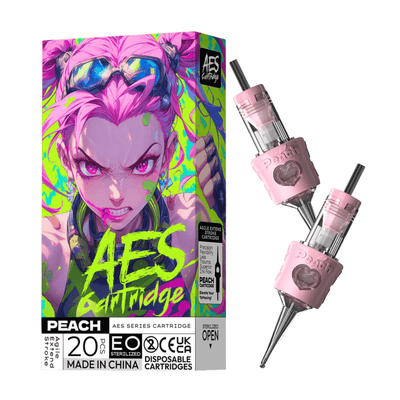
Product insight: Peach AES PMU Cartridges
Built for delicate PMU and fine line work, with extended tip visibility, smooth pigment flow, and low-friction precision. Anti-bend AES needles are compatible with most PMU and tattoo machines. Box of 20, individually packed for sterile single-use handling. Available at Magnum Tattoo Supplies.
How to Change PMU Cartridges Safely
Before inserting a new cartridge, wear gloves and make sure your workstation is fully set up with barrier protection in place. Open the cartridge packaging just before use. Do not leave unsealed cartridges sitting on your tray. Handle the cartridge by the housing, and avoid touching the needle tip.
When removing a used cartridge, place it directly into the sharps container without setting it down anywhere. Do not recap needles. Recapping is one of the most common causes of needlestick injuries in clinical settings.
PMU vs Tattoo Cartridges: A Hygiene Perspective
The core hygiene principles are the same for both. Both are sterile disposable equipment. Both require proper sharps disposal after a single use. But there are design differences worth understanding.
PMU cartridges typically use finer needle configurations, designed for precision pigment implantation at shallow depths. The tip and needle profile are engineered for brow, lip, and eyeliner work rather than bold lines or large-area shading.
The membrane safety system in PMU cartridges prevents fluid from travelling back up into the machine body. Since most PMU machines cannot be autoclaved, the sterile cartridge design serves as your primary barrier against contamination at the needle end.
Choosing the Right Needle Configuration
The answer depends on the treatment. Round liners are used for precise outline work and fine detail on brows and eyeliner. Round shaders and magnums are used for soft shading, ombre-brow techniques, or lip-blush work.
A quick guide to common needle configurations:
-
1RL: Ultra-fine single needle for hair strokes and detailed linework.
-
3RL or 5RL: Small groupings for fuller lines or nano brow techniques.
-
5RS or 7RS: Controlled shading for soft fills.
-
Nano needles: Extremely fine diameter for sensitive areas and minimal trauma.
Every cartridge, regardless of size, is single-use. Clinical sanitation practices apply equally across all configurations.
Why Needle Choice Affects Safety and Results
The wrong needle creates unnecessary trauma. A needle that is too large for the area being treated causes more bleeding, swelling, and surface damage than necessary. That increases the risk of infection and extends healing time.
A well-chosen needle at the correct depth causes minimal disruption to the skin. That means less likelihood of fluid pooling, less scabbing, and a cleaner environment for the pigment to settle.
Your cleaning protocol should remain consistent regardless of needle size or depth.
Understanding Needle Depth and Hygiene Standards for Permanent Makeup Studios
Needle depth refers to how far the needle protrudes beyond the tip of the cartridge during operation. For PMU, you are working in the upper dermis. Typical depth for brow work ranges from 0.5mm to 1.5mm, depending on the client's skin.
Going too deep causes blowouts and pigment migration. Too shallow, and the pigment sits in the epidermis, fading quickly.
Health and safety compliance in the UK also requires that you document the cartridge type and configuration used for each client in your treatment records. It supports traceability in the event of a complaint or adverse reaction.
Product insight: AVA - Soulnova Permanent Makeup Kit
Everything you need to start or upgrade your PMU setup, in one kit. The AVA Soulnova Permanent Makeup Kit includes the Soulnova pen, built specifically for precision pigment work on brows, lips, eyeliner, and more. Designed by AVA alongside professional PMU artists, this kit brings together the tools that make clean, controlled permanent makeup work possible from day one.
Available in pink. Perfect for PMU artists who want a reliable, ready-to-go solution without the guesswork.
Precision Cartridges and Advanced PMU Needle Technology
Fine-liner cartridges for PMU precision are the foundation of hairline brow work, precise eyeliner definition, and detailed lip outlines. They are designed with tight needle groupings and a thin profile, allowing the artist to see exactly where they are working.
The key features to look for are a reliable membrane system, consistent needle alignment, and secure housing that does not flex or wobble during use.
Nano-needle PMU cartridges are becoming the go-to choice for artists working on sensitive skin or for clients who prefer a lower-trauma approach. Modern PMU cartridges arrive pre-sterilised from the manufacturer. Your machine body should still be cleaned and barrier-wrapped. But the cartridge itself is already sterile when it comes out of the packet, provided you handle it correctly.
Conclusion
Hygiene standards for permanent makeup studios are not a box-ticking exercise. They are the structure that makes safe, professional practice possible. Every procedure you carry out depends on the hygiene decisions you make before, during, and after the session.
Infection control protocols, sterile disposable equipment, and cross-contamination prevention all work together. Remove any one of them and your studio becomes a risk to your clients and your business.
Use professional hygiene practices, handle every cartridge correctly, and stay up to date with health and safety compliance requirements in your area. Your clients are trusting you with their skin. That trust is worth protecting.
Browse the full range of PMU supplies, cartridges, gloves, and consumables at Magnum Tattoo Supplies to keep your studio fully stocked with professional-grade equipment.
FAQs
Are PMU cartridges single-use?
Yes. Every PMU cartridge is designed for single use only. They are pre-sterilised and cannot be pre-sterilised safely. After one session, they go directly into a sharps container.
Can you reuse PMU needle cartridges?
No. Reusing PMU cartridges is unsafe and illegal in the UK. It creates a serious risk of cross-contamination and bloodborne pathogen transmission between clients.
How do you safely change PMU cartridges?
Wear gloves, handle the cartridge only by the housing, and open the packaging immediately before use. After use, remove the cartridge and place it directly into a sealed sharps container without recapping or setting it down.
What needle configuration is used for PMU?
It depends on the treatment. Round liners (1RL, 3RL) are used for fine details and hair strokes. Round shaders and magnums are used for shading, ombre brows, and lip blush.
What size PMU cartridge should I use?
For fine hair strokes and detailed brow work, start with a 1RL or Nano needle. When transitioning to shading or ombré effects, a 3RL or a small Magnum is typically preferred for smooth, even pigment distribution. For lip blush, a 3RL or 5CM allows for efficient coverage and soft borders, while eyeliner procedures generally require the control of a 1RL or 3RL to ensure crisp, safe application near the lash line.
Shop product