Ink
Ink


 Machines


 Cartridges


 Studio supplies


 Power & batteries


 Aftercare


 Traditional tattooing


 Apprentice


 Piercing & jewellery


 PMU supplies


 New arrivals
 Sale
Sale
 Gift vouchers
 Shop all


 March 12, 2026
-
6 months ago
March 12, 2026
-
6 months ago
When you are starting as a tattoo artist, the number of needle options can feel overwhelming. Round liners, curved magnums, flat shaders. What do they all mean? And more importantly, which one do you actually reach for?
Understanding tattoo cartridges and needle configurations is one of the first things you need to nail. Get it right, and your lines are clean, your shading is smooth, and your ink sits properly in the skin. Get it wrong, and you are working against yourself from the very first pass.
This guide breaks it all down simply and clearly, without jargon.
Quick Takeaways
Before we dive in, here are the essentials to keep in mind as you read through this guide.
-
The number before the code indicates how many needles are in the grouping.
-
Needle codes like RL, RS, M1, and CM describe the shape and grouping of the needles.
-
Different configurations are designed for different tasks: lining, shading, colour packing, and blending.
-
Choosing the wrong needle for the job will affect your results and your client's skin.
-
Knowing your needle configurations by name is essential for any professional artist working in the UK today.
What the Code Actually Means
Every needle configuration you pick up has a code on it. Something like 9RL or 11CM. It looks technical, but the logic is simple once you see it.
Reading the Numbers and Letters
The number tells you how many needles are bundled together. The letters tell you the shape and configuration. A 5RL has five needles. A 9RL has nine. More needles mean a wider stroke. Fewer needles mean a finer, more controlled line.
Here is a quick tattoo needle configuration chart to reference as you build your knowledge.
|
Code |
Configuration |
Example Sizes |
Best For |
|
RL |
Round Liner |
3RL, 5RL, 7RL, 9RL |
Fine lines, outlines |
|
RS |
Round Shader |
5RS, 7RS, 9RS |
Shading, soft fills |
|
M1 / MG |
Magnum |
7M1, 9M1, 11M1 |
Large area shading |
|
RM / CM / SEM |
Curved Magnum |
9RM, 11RM, 13RM |
Smooth blends, black and grey |
|
F |
Flat |
7F, 9F |
Precise colour fills |
The Main Needle Types, Explained
Each needle configuration has a specific purpose. Knowing when to use each one is what separates guesswork from professional technique.
Round Liners
A round liner is a tightly grouped cluster of needles arranged in a circle. The close grouping creates a sharp, concentrated point that deposits ink in a precise line.
Round liners are your go-to for outlines, script, and any fine line work. If you are working on a piece that needs crisp, controlled marks, this is the configuration you want. The best needle for fine line tattoos is almost always a tight round liner, typically in the 1RL to 3RL range.
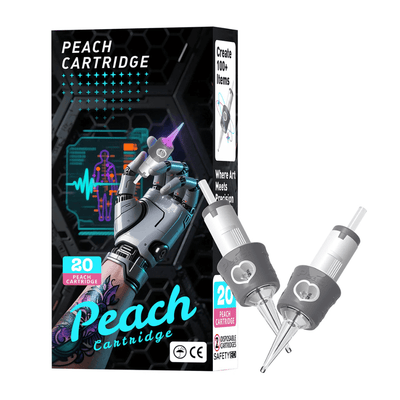
Peach Tattoo Cartridges (20PCS) Round Liners (RL)
Crafted from 304 medical-grade stainless steel with precise needle alignment to reduce skin trauma. EO gas is used to sterilise and individually package in sterile blister packs. Compatible with most rotary and coil tattoo machines.
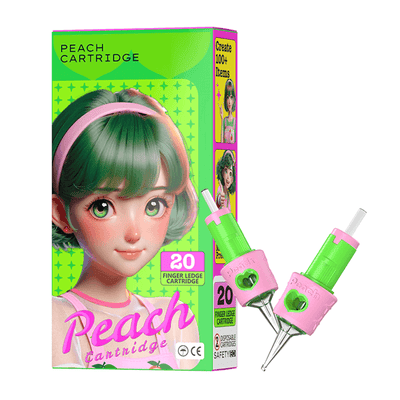
Peach COG Tattoo Cartridges (20PCS) Round Liners (RL)
Precision-welded, auto-arranged needles on a single plane for consistent punctures and reduced skin trauma. Features a soft TPE finger ledge for grip and an extended, transparent tip for better visibility of ink flow.
Round Shaders
Round shaders share the circular grouping of a round liner, but the needles are spread more loosely. That spacing changes everything. Instead of a sharp point, you get a broader contact area, allowing ink to spread more gently.
Round shaders are flexible enough to blend, softly shade, and perform solid-fill work on smaller areas. The looser grouping also means better ink saturation without overworking the skin.
Magnum Needles (M1)
A magnum tattoo needle is made up of two rows of needles arranged side by side in a flat pattern. That dual row design covers ground quickly and holds more ink, making it ideal for large shading areas and backgrounds.
Reach for a magnum when you are filling in backgrounds, shading large body panels, or doing solid colour work across larger sections. It is one of the most widely used needle configurations for professional-level work.
Curved Magnum vs Flat Magnum: Which One Do You Need?
It is one of the most common questions for apprentices. Both are magnums. Both cover large areas. But they behave quite differently on the skin and produce different results depending on the style you are working in.
What Is a Curved Magnum?
A curved magnum, also called a round magnum or soft-edge magnum, has needles that arc outward from the centre. That curve allows the needle to follow the skin's natural contours more closely, resulting in smoother ink delivery and less trauma.
The curved magnum is the better choice for smooth black-and-grey shading and gentle gradients. The soft, even coverage suits the subtle tonal shifts that make black-and-white work look polished and professional.
What Is a Flat Magnum?
A flat magnum sits in a straight line and suits harder-edged coverage and colour filling. The difference between a curved magnum and a flat magnum comes down to control and finish. Where the curved magnum follows the contours of the skin, the flat magnum delivers a more uniform stroke that works well for bolder, more saturated areas.
For black and grey shading in particular, the best needle configuration is almost always a curved magnum. For bold colour packing across flat areas, the flat magnum gives you a harder edge and faster coverage.
Choosing the Right Needle for Your Style
Your choice of needle configuration should always come from your technique and your subject matter. There is no single correct answer, but there are better starting points depending on the work you do most.
Fine Line and Detail Work
The best needle for fine line tattoos is almost always a tight round liner in the 1RL to 3RL range. The small grouping count gives you precision and lets you work on details without losing control.
Needle taper also plays a role here. A longer taper allows the needle to pierce more smoothly and deposit ink with less resistance, which matters for soft gradients and realistic shading.
Shading and Blending
For shading and blending, move towards round shaders or curved magnums, depending on the scale of the work. Smaller areas suit round shaders. Larger sections benefit from the wider coverage of a curved magnum.
The tattoo needle gauge determines the thickness of each needle. A thinner gauge has less impact on the skin per pass, which is well-suited to delicate or detail-focused work. Thicker gauges hold more ink and suit bold, fast coverage.
Cartridges vs Traditional Needles: What Should Apprentices Use?
Most artists working today use cartridge needles rather than traditional needles in tubes. Cartridges are faster to swap between sessions, safer in terms of needle stick risk, and more compatible with modern pen-style machines.
Why Cartridges Make Sense for Apprentices
As an apprentice, cartridges also make it easier to focus on technique rather than setup. You can quickly identify the needle configuration from the packaging, switch to a new size without stopping your flow, and spend more time practising your craft.
Brands like Kwadron and Peach produce cartridges across every standard configuration, from the most delicate round liners to large curved magnums. Each product listing at Magnum Tattoo Supplies includes the configuration type and size, so you always know exactly what you are picking up.
Conclusion
Needle configurations are not complicated once you understand the system. The code on every cartridge tells you the shape, grouping, and size. All of those details matter. They affect how ink enters the skin, how much coverage you get per pass, and how the finished result looks and heals.
Start with the core needle configurations: round liner for lines, round shader for soft shading, curved magnum for large-area blending, and black-and-grey work. Build from there as your technique develops.
Browse the full range of tattoo needle cartridges at Magnum Tattoo Supplies. Everything is clearly labelled by type and size, so you can find exactly what you need without second-guessing yourself.
FAQs
What does RL mean in tattoo needles?
RL stands for Round Liner. The needles are grouped in a tight circular cluster to create a sharp point ideal for line work and outlines.
What is a magnum tattoo needle used for?
A magnum tattoo needle is used for shading large areas, colour packing, and background work. Its dual row design covers skin quickly and holds more ink than a round needle.
What is the best needle for fine line tattoos?
A tight, round liner in the 1RL to 3RL range gives you the most precision for fine-line work. The small grouping count allows clean, controlled deposits without the line spreading.
What is the difference between a curved magnum and a flat magnum?
A curved magnum has needles that arc outward, allowing it to follow the natural contour of the skin. A flat magnum sits in a straight line and suits harder-edged coverage and colour filling.
What does the number in front of the needle code mean?
The number indicates how many individual needles are in the grouping. A 5RL has five needles. A 9RL has nine. More needles produce a wider stroke.
Are cartridge needles better for apprentices?
Yes, for most apprentices, cartridge needles are a practical starting point. They are quick to change, clearly labelled by configuration, and compatible with most modern machines.
Shop product